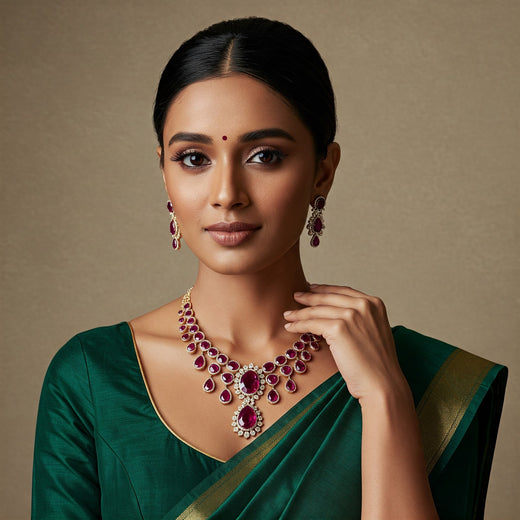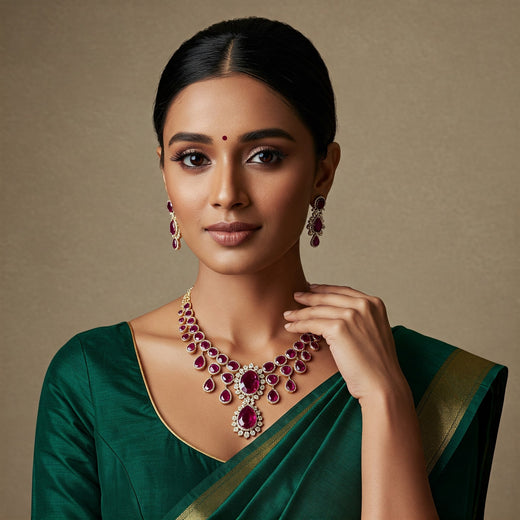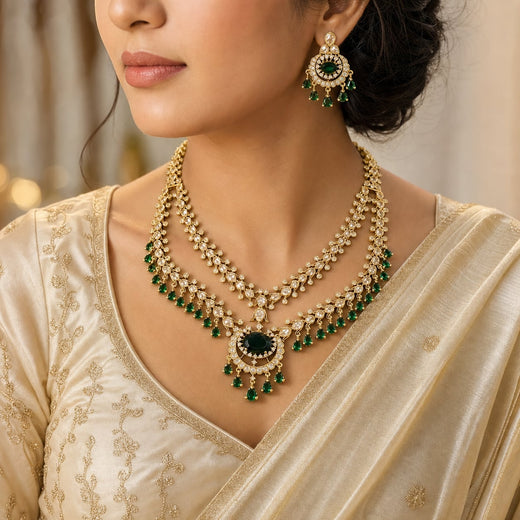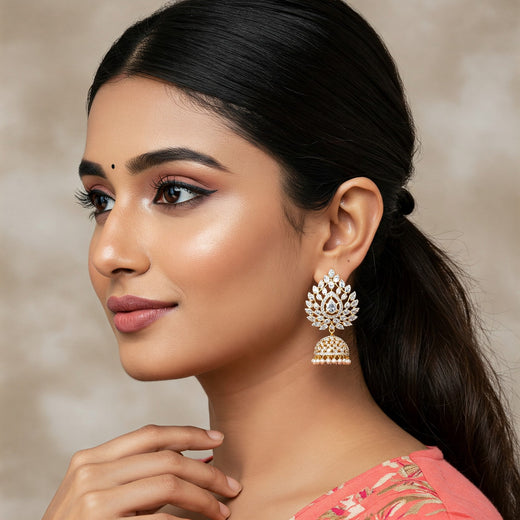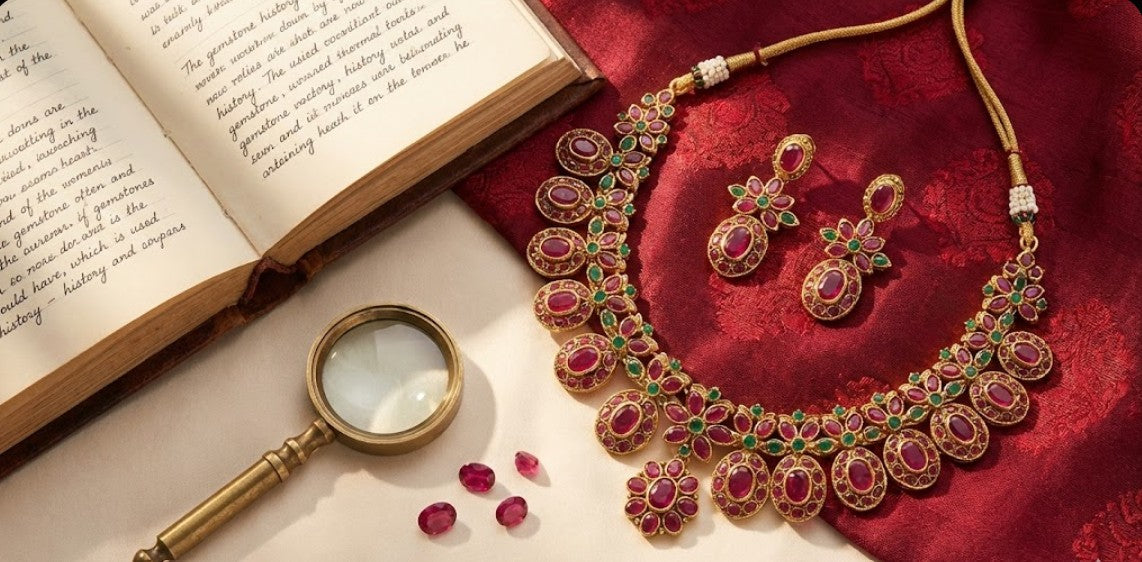
A flat lay photograph of a traditional gold-plated feelori ruby and emerald floral necklace set, similar to the FeelOri heritage collection, resting on antique brocade silk beside an open journal, a magnifying glass, and loose gemstones.

Ruby Necklace: Heritage Guide & Quality Factors | FeelOri

Introduction

Ruby necklaces represent one of the most prestigious forms of gemstone jewelry, combining the corundum mineral's exceptional hardness of 9 on the Mohs scale with cultural significance spanning over 2,500 years across Asian, European, and Middle Eastern civilizations. The ruby's distinctive red coloration derives from chromium impurities within the aluminum oxide crystal structure, with concentrations between 0.1% and 3% producing the characteristic crimson hues. According to the Gemological Institute of America (GIA), rubies exceeding five carats of fine quality remain exponentially rarer than diamonds of comparable size, with fewer than 1% of mined rubies meeting gem-quality standards. Ruby necklaces have adorned royalty, religious leaders, and cultural icons throughout history, serving as symbols of power, protection, and passion. The combination of exceptional durability, intense color saturation, and historical reverence positions ruby necklaces as both wearable art and investment pieces within the heritage jewelry category.

Historical Context

The historical trajectory of ruby necklaces extends back to approximately 2,500 BCE in the Mogok Valley of Myanmar (Burma), where archaeological evidence reveals early mining operations and trade networks. Sanskrit texts from 200 BCE reference rubies as "ratnaraj" or "king of precious stones," documenting their use in elaborate necklace designs worn by Indian royalty and religious figures. The Brahmin caste system classified rubies into four distinct groups based on color intensity and clarity, with the finest specimens reserved exclusively for necklaces worn during ceremonial occasions. Byzantine artisans during the 6th-10th centuries CE developed the cabochon cutting technique specifically for ruby necklaces, creating smooth, domed surfaces that maximized color saturation and internal luminescence.

European royal courts during the Renaissance period (14th-17th centuries) commissioned ruby necklaces as diplomatic gifts and inheritance pieces, with the Medici family's inventory records from 1492 documenting over 40 ruby necklaces valued above their diamond counterparts. The Mughal Empire (1526-1857) elevated ruby necklace craftsmanship to unprecedented levels, combining Burmese rubies with intricate gold work and enamel techniques known as "meenakari." Historical records from Emperor Shah Jahan's court indicate that master craftsmen required 18-24 months to complete a single ceremonial ruby necklace, employing over 200 individual gemstones in graduated sizes.

The discovery of Thai ruby deposits in the 1850s and subsequent Sri Lankan sources during the 1870s democratized ruby necklace availability beyond aristocratic circles, though Burmese "pigeon's blood" rubies maintained their premium status. The British Crown Jewels include the Timur Ruby necklace, acquired in 1849, featuring 361-carat polished rubies with inscriptions dating to 1612. Cultural traditions across Southeast Asia incorporated ruby necklaces into bridal jewelry sets, with Thai customs requiring brides to wear multi-strand ruby necklaces symbolizing prosperity and fertility. According to research by the Natural History Museum of London, over 75% of historical ruby necklaces examined contain heat-treated stones, a practice documented in Sanskrit texts from the 8th century CE.

Materials & Craftsmanship

Ruby necklaces utilize corundum crystals (Al₂O₃) with chromium substitution creating the characteristic red coloration, requiring precise chemical conditions during formation over millions of years within metamorphic rock environments. The hexagonal crystal structure exhibits trigonal symmetry with refractive indices between 1.762-1.770, producing the distinctive brilliance when properly faceted. According to GIA standards, rubies for necklace applications must demonstrate minimum clarity grades of "slightly included" (SI), with inclusions such as rutile needles (silk), crystal formations, and fingerprint patterns affecting both appearance and structural integrity. Heat treatment at temperatures between 1,700-1,800°C modifies rutile silk patterns and dissolves certain inclusions, a process applied to approximately 95% of commercial rubies according to the International Colored Gemstone Association (ICA).

Traditional ruby necklace construction employs 18-22 karat gold settings to complement the gemstone's warm red tones, with platinum and white gold gaining popularity during the Art Deco period (1920-1939). The setting techniques vary significantly: prong settings (typically 4-6 prongs) maximize light penetration and brilliance; bezel settings provide superior protection for high-value stones; and pavé settings create continuous ruby surfaces in contemporary designs. Master jewelers calculate precise depth-to-diameter ratios for ruby placement, with optimal proportions ranging from 60-70% to prevent excessive light leakage through the pavilion facets.

Authentication markers for genuine ruby necklaces include distinctive fluorescence under ultraviolet light (strong red fluorescence for Burmese rubies, weaker response for Thai specimens), characteristic inclusion patterns visible under 10x magnification, and consistent color distribution throughout the crystal structure. Laboratory analysis using Raman spectroscopy identifies chromium concentration levels and crystal structure integrity, while X-ray fluorescence determines trace element compositions distinguishing natural from synthetic rubies. According to research published in Gems & Gemology (2019), approximately 30% of rubies marketed in necklaces contain lead-glass filling treatments to improve clarity, requiring specialized detection methods including thermal reaction testing.

The craftsmanship hierarchy for ruby necklaces encompasses several skill levels: basic stringing techniques for beaded designs; intermediate metalwork for simple prong settings; advanced techniques including invisible settings where metal remains hidden beneath stone surfaces; and master-level work involving custom-cut rubies matched for color consistency across 50+ stones in graduated necklace designs. Traditional Burmese craftsmen employ a technique called "yoe-mya" involving gold wire wrapped around individual rubies before assembly, creating flexible necklace structures that conform to neck contours while maintaining security.

Design Styles & Variations

Ruby necklace design traditions reflect distinct regional aesthetics and cultural symbolism across geographical origins. Indian ruby necklaces feature three primary styles: the "ranihaar" (queen's necklace) extends 24-30 inches with multiple ruby strands and pearl accents; the "satlada" incorporates seven distinct strands representing the seven sacred rivers; and the "aad" or choker style positions large central rubies surrounded by smaller stones in concentric patterns. According to the National Museum of India's jewelry archives, traditional South Indian temple jewelry designs utilize rubies in "kemp" settings, where uncut or roughly faceted rubies are set in gold with minimal metalwork visible, emphasizing the gemstone's natural form.

Burmese ruby necklaces traditionally follow the "yadanar" design principle, featuring graduated ruby sizing from 1-2 carats at the clasp to 5-10 carats at the central pendant position. Historical pieces from the Konbaung Dynasty (1752-1885) demonstrate the "shwe-chi-doe" technique, alternating rubies with gold beads featuring intricate repoussé work depicting mythological creatures. Thai ruby necklaces incorporate the "phra kruang" amulet style, where individual rubies are enclosed in gold frames suspended from chain links, creating movement and light reflection from multiple angles.

European ruby necklace traditions diverged significantly from Asian aesthetics during the Victorian era (1837-1901), emphasizing symmetrical arrangements with rubies alternating with diamonds in geometric patterns. The Edwardian period (1901-1910) introduced delicate platinum filigree work supporting ruby clusters, with necklace lengths extending 16-18 inches to complement high-necked fashions. Art Deco designs (1920-1939) revolutionized ruby necklace aesthetics through angular geometric forms, calibré-cut rubies fitted precisely into channel settings, and contrasting color combinations pairing rubies with emeralds or sapphires.

Contemporary ruby necklace designs incorporate several modern variations: tension settings suspend rubies between metal terminals using mechanical pressure rather than traditional prongs; illusion settings employ reflective metal surfaces to enhance apparent ruby size; and convertible designs allow necklaces to separate into bracelets or brooches. According to data from the International Gem Society, minimalist designs featuring single statement rubies (3-5 carats) on simple chain necklaces increased 45% in popularity between 2015-2020, reflecting contemporary aesthetic preferences for understated luxury.

Design Style Origin Period Typical Ruby Count Characteristic Length Primary Setting Type
Ranihaar 16th-19th century India 150-300 stones 24-30 inches Kundan/Meenakari
Rivière 18th century Europe 15-30 stones 16-18 inches Prong/Collet
Yadanar 18th-19th century Burma 30-60 graduated 18-22 inches Bezel/Prong
Art Deco 1920-1939 Europe/America 40-100 calibré-cut 15-17 inches Channel/Pavé
Contemporary Pendant 2000-present Global 1-3 statement stones 16-20 inches Tension/Bezel

Quality Factors

Ruby quality assessment for necklace applications follows the "Four Cs" framework adapted specifically for colored gemstones: color, clarity, cut, and carat weight, with color contributing approximately 50-60% of overall value determination according to GIA research. The most valuable ruby color designation, "pigeon's blood" (Burmese: "ko-twe"), describes a pure red hue with slight purple undertones and medium-dark tone (70-80% on the tone scale), exhibiting strong fluorescence under natural daylight. Color grading systems developed by the Gübelin Gem Lab classify rubies across three parameters: hue (primary color), tone (lightness/darkness), and saturation (intensity), with optimal combinations scoring 80+ points on the 100-point scale.

Clarity evaluation for ruby necklaces differs fundamentally from diamond grading, as most rubies contain visible inclusions that serve as authenticity markers rather than defects. The GIA clarity scale for rubies recognizes three categories: "eye-clean" stones showing no inclusions under normal viewing conditions (representing less than 5% of gem-quality rubies); "slightly included" specimens with minor silk or crystal inclusions visible under 10x magnification; and "included" grades where inclusions affect transparency and brilliance. According to research published in the Journal of Gemmology (2021), rubies in high-quality necklaces typically range between VVS (very very slightly included) to VS (very slightly included) grades, with matching clarity across multiple stones adding 15-25% premium value.

Cut quality determines light performance and color distribution in ruby necklaces, with optimal proportions varying based on rough crystal shape and inclusion patterns. Traditional oval and cushion cuts dominate ruby necklace designs, featuring crown angles between 35-40 degrees and pavilion depths of 43-50% relative to girdle diameter. Modern precision cutting employs computer-aided design to maximize color saturation while maintaining appropriate weight retention from rough material. The Gemological Institute of America reports that well-cut rubies can appear up to 20% more saturated in color compared to poorly proportioned stones of identical chemical composition.

Carat weight considerations for ruby necklaces involve both individual stone sizes and total necklace weight, with graduated designs requiring precise weight distribution to achieve visual balance. Rubies exceeding three carats demonstrate exponential value increases, with five-carat specimens of fine quality commanding values 10-15 times higher per carat than one-carat equivalents according to the Gemval pricing index. Authentication methods include advanced spectroscopic analysis (FTIR, UV-Vis, Raman) identifying treatment histories, origin determination through trace element analysis, and inclusion pattern documentation establishing natural versus synthetic origin.

Quality Factor Premium Grade Commercial Grade Impact on Value
Color (Hue/Tone/Saturation) Pigeon's blood, 75-80% tone, 85%+ saturation Medium red, 60-70% tone, 70% saturation 50-60% value determination
Clarity Eye-clean to VVS VS to SI 15-20% value determination
Cut Quality Excellent symmetry, optimal proportions Good symmetry, acceptable proportions 15-20% value determination
Carat Weight (per stone) 3+ carats 0.5-2 carats 10-15% value determination
Origin Burma (Mogok), unheated Thai, heated 5-10% value determination

Wearing & Styling

Ruby necklace wearing traditions reflect deep cultural symbolism and occasion-specific protocols across different societies. In Indian wedding ceremonies, brides traditionally wear ruby necklaces during the "pheras" (sacred vows), with the gemstone symbolizing marital prosperity and protection according to Vedic traditions documented in texts dating to 1500 BCE. The positioning of ruby necklaces varies by regional custom: South Indian brides layer multiple ruby necklaces of different lengths (choker, mid-length, and long designs) totaling 50-100 carats, while North Indian traditions favor single statement pieces with large central rubies surrounded by diamond accents.

Burmese cultural practices associate ruby necklaces with Sunday (ruled by the Sun in traditional astrology), recommending wear during important negotiations, public appearances, and ceremonial functions. Thai royal protocol historically restricted certain ruby necklace designs to members of the Chakri Dynasty, with specific patterns and stone counts reserved exclusively for royal use until the early 20th century. Middle Eastern traditions incorporate ruby necklaces into bridal "mahr" (dowry jewelry), with Palestinian and Jordanian customs favoring long ruby chains extending 24-30 inches worn over traditional embroidered dresses.

Contemporary styling approaches for ruby necklaces emphasize versatility and occasion-appropriate selection. Statement ruby necklaces featuring large central stones (5+ carats) pair effectively with solid-colored evening wear in complementary tones (deep blues, blacks, or neutral creams), allowing the gemstone's color to dominate visual focus. Multi-strand ruby necklaces suit formal occasions including galas, weddings, and cultural celebrations, traditionally worn with upswept hairstyles and strapless or boat-neck garments that provide unobstructed neckline visibility. Delicate ruby pendant necklaces integrate into professional and casual wardrobes, offering subtle color accents compatible with both traditional and contemporary attire.

Layering techniques for ruby necklaces require attention to length differentiation and style compatibility: combining a 16-inch ruby choker with an 18-inch simple chain creates dimensional interest; pairing a ruby pendant with longer pearl strands provides textural contrast; and mixing ruby necklaces with complementary gemstones (emeralds, sapphires) follows color theory principles established in traditional jewelry design. According to styling research from the Fashion Institute of Technology, ruby necklaces demonstrate optimal visual impact when positioned against skin tones with warm undertones, with the chromium-induced red coloration complementing melanin-rich complexions particularly effectively.

Care & Maintenance

Ruby necklace maintenance protocols leverage the gemstone's exceptional durability (Mohs hardness 9) while addressing specific vulnerabilities in settings and metal components. Regular cleaning procedures recommended by the GIA involve lukewarm water with mild soap solution, soft-bristled brushes for detailed work around settings, and thorough rinsing followed by air-drying on lint-free cloths. The corundum crystal structure resists most household chemicals, though prolonged exposure to hydrofluoric acid and concentrated alkaline solutions can cause surface etching. According to research from the Gemological Institute of Thailand, ultrasonic cleaning remains safe for untreated rubies without significant fractures, though stones with lead-glass filling treatments require manual cleaning only to prevent treatment degradation.

Storage requirements for ruby necklaces emphasize separation from harder materials (diamonds) that could cause abrasion, and softer gemstones (pearls, opals) that rubies might damage through contact. Individual fabric-lined compartments or soft pouches provide optimal storage conditions, maintaining stable humidity levels between 45-55% to prevent metal tarnishing while avoiding excessive moisture that promotes oxidation. Professional jewelers recommend annual inspections examining prong integrity, clasp functionality, and stone security, with statistical analysis from insurance claims data indicating that 60% of ruby losses from necklaces result from weakened prongs rather than clasp failures.

Specialized maintenance considerations apply to treated rubies, which constitute approximately 95% of commercial stones according to ICA data. Heat-treated rubies require no special care beyond standard protocols, as the treatment creates permanent color and clarity modifications stable under normal wearing conditions. Lead-glass filled rubies demand gentler handling, avoiding ultrasonic cleaners, steam cleaning, and reheating during jewelry repairs that could cause filling material degradation. Surface-diffused rubies, where color penetrates only 0.2-0.5mm depth, require careful repolishing procedures to prevent color layer removal.

Professional maintenance schedules recommended by heritage jewelry conservators include: annual professional cleaning and inspection for frequently worn pieces; bi-annual treatments for occasional-wear necklaces; and comprehensive condition assessments every 3-5 years documenting stone security, metal wear patterns, and treatment stability. Restringing protocols for beaded ruby necklaces specify silk thread replacement every 2-3 years for regularly worn pieces, with individual knots between stones preventing total loss if strand breakage occurs. According to data from the American Gem Society, proper maintenance protocols extend ruby necklace lifespan indefinitely, with well-maintained pieces retaining 95-98% of original structural integrity over multi-generational ownership periods.

Buying Considerations

Ruby necklace acquisition requires comprehensive evaluation of gemological characteristics, craftsmanship quality, and documentation authenticity. Laboratory certification from recognized institutions (GIA, Gübelin, SSEF, AGL) provides essential verification of ruby authenticity, treatment disclosure, and origin determination when applicable. According to consumer protection research, approximately 40% of rubies sold without laboratory certification contain undisclosed treatments or synthetic material, emphasizing certification importance for significant purchases. Certificates should specify color grade, clarity assessment, cut quality evaluation, carat weight, treatment history (heated, filled, diffused, or unheated), and origin determination when conclusive.

Authentication techniques accessible to buyers include basic fluorescence testing using longwave ultraviolet light (Burmese rubies typically show strong red fluorescence, while Thai stones exhibit weaker responses), inclusion examination under 10x magnification revealing characteristic silk patterns or crystal formations, and color consistency assessment across multiple stones in necklace designs. Synthetic rubies, produced through flame-fusion, flux-growth, or hydrothermal methods, demonstrate characteristic curved growth lines (flame-fusion) or distinctive inclusion patterns differentiating them from natural stones. According to GIA research, synthetic rubies represent approximately 15% of the commercial market, with disclosure requirements varying significantly across international jurisdictions.

Market dynamics for ruby necklaces reflect several influential factors: Burmese ruby availability decreased approximately 60% following 2008 import restrictions and subsequent political developments, elevating values for certified Burmese stones; Mozambican ruby discoveries since 2009 introduced significant new supply, though quality distributions differ from traditional sources; and treatment technology advances enable enhancement of previously unmarketable material, expanding commercial availability while creating complex value stratifications. The colored gemstone market demonstrates different dynamics than diamonds, with ruby values influenced heavily by origin, treatment status, and individual stone characteristics rather than standardized pricing matrices.

Quality indicators beyond certification include craftsmanship assessment examining setting security, metal quality (hallmarks indicating gold purity), clasp functionality and safety mechanisms, and overall design execution. Graduated ruby necklaces require particular attention to color matching across stones, with premium pieces demonstrating consistent hue, tone, and saturation throughout the entire length. According to heritage jewelry specialists, custom-designed ruby necklaces typically require 6-12 months production time for stone sourcing, matching, and assembly, with this timeline serving as a quality indicator distinguishing bespoke work from mass-produced alternatives.

Buyer protection considerations include written purchase agreements specifying all gemological characteristics, treatment disclosures, and return policies; independent appraisal within 30 days of purchase by qualified gemologists; and insurance documentation with specialized jewelry coverage including agreed-value policies rather than standard homeowner's provisions. The American Gem Society recommends buyers allocate 10-15% of purchase value toward comprehensive documentation, independent verification, and insurance establishment, protecting long-term investment value and authenticity assurance.


Heritage Specimens Mentioned in this Article

Back to blog