
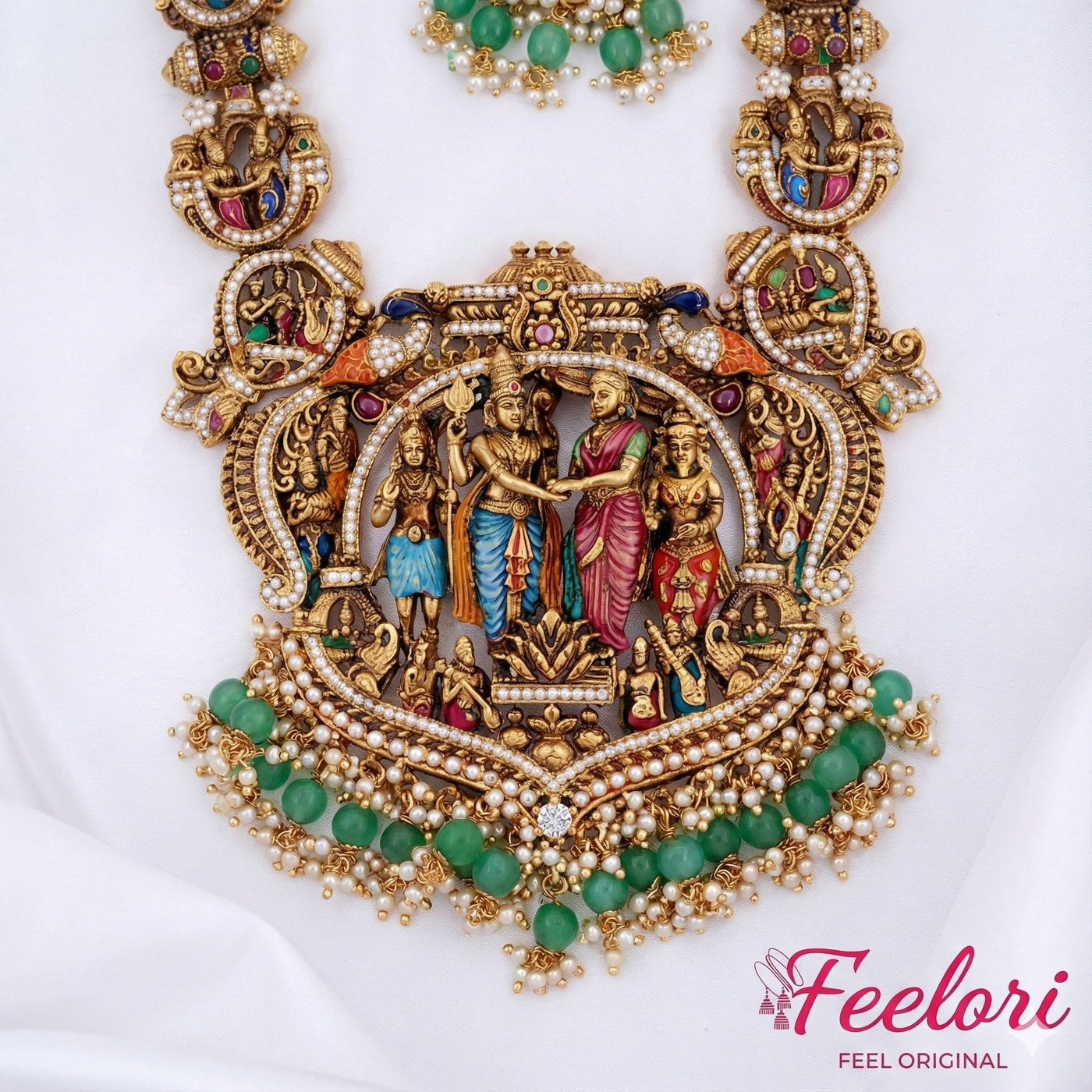
Short answer: Temple jewellery describes a design tradition shaped by sacred iconography, South Indian ornament and forms associated with temple culture. Antique jewellery can mean a genuinely old object, but in modern fashion jewellery it often describes an intentionally aged finish. The two ideas can overlap, but they are not the same.
This guide explains that difference, the history behind the style, how to recognise popular deity motifs and what to check before buying a modern temple jewellery set. It is written for shoppers who want cultural context and clear product facts, not vague claims.
Editorially reviewed by FeelOri founder Pooja Tunk. Updated August 2026.
What is temple jewellery?
Temple jewellery is a broad contemporary name for jewellery that draws on the visual language of South Indian sacred art and ornament. Common features include sculptural deity panels, lotus forms, peacocks, yali or makara-inspired creatures, floral scrollwork, coin-like links, bells, pearls and richly coloured stones or enamel.
It is useful to think of temple jewellery as a design family, not a guarantee of one material, one age or one method of manufacture. A piece may be made in precious metal, or it may be modern fashion jewellery made in brass, copper or alloy with an antique-toned polish. The product description should tell you which.
The term is also used for several silhouettes: a close-fitting temple choker, a medium necklace, a long haram, a pendant necklace, jhumkas, bangles, vaddanam waist belts and complete necklace-and-earring sets. Length and construction matter as much as motif when deciding how a piece will sit.
Temple jewellery vs antique jewellery: what is the difference?
| Question | Temple jewellery | Antique jewellery or antique polish |
|---|---|---|
| What does the term describe? | Primarily the design language: deity, sacred, architectural and South Indian ornamental motifs. | Either the age of a genuine old piece or, more commonly in fashion jewellery, an aged-looking surface finish. |
| Does it identify the base metal? | No. Check the product facts for brass, copper, alloy, silver or gold. | No. Antique polish can be applied to different base metals. |
| Must it include a deity? | No. Many designs use peacocks, lotus, floral, coin, yali or architectural motifs without a central deity. | No. Antique finish appears across many jewellery styles. |
| Can one piece be both? | Yes. A modern temple necklace may have an antique gold-toned polish, so it is both temple-inspired in design and antique-finished in appearance. | |
FeelOri terminology note: When FeelOri says antique polish, it describes the finish. It does not mean the piece is an archaeological object, a historical antique or solid gold. Material, stones, finish, weight and set contents should be read as separate product facts.
Where does the temple jewellery tradition come from?
Jewellery has long had both sacred and secular roles in India. Temple sculpture shows deities with elaborate crowns, necklaces, earrings, armlets and waist ornaments, while inscriptions record gifts of jewellery made for worship and adornment. The Brihadisvara Temple records published by the Indira Gandhi National Centre for the Arts include lists of jewelled ornaments presented for temple images. This is strong evidence for the importance of ornament within South Indian temple culture; it does not mean every modern product called temple jewellery is a direct copy of one historical object.
South Indian jewellery traditions also moved beyond the shrine. They appeared in courtly dress, family ornament and performance. The Victoria and Albert Museum's Oppi Untracht archive describes the field as both “secular and sacred,” a helpful reminder that these designs have never belonged to only one setting.
Over time, jewellers translated sculptural forms into wearable compositions. Modern makers continue that translation through embossed relief, cast motifs, stone setting, enamel or Meenakari colour, pearl fringes and antique-toned polish. Some pieces closely reference historic ornament; others combine recognisable motifs in a new fashion-jewellery design.
How to recognise common deity motifs
A product title should name a deity only when the iconography is clear. Small sculptural details can be difficult to read in a single photograph, so use front and close-up images before deciding. These are common visual cues:
Lakshmi jewellery
Lakshmi is commonly shown seated or standing on a lotus, sometimes with elephants or lotus-bearing attendants. Lakshmi motifs are widely associated in Hindu tradition with prosperity and auspiciousness. In jewellery, the figure may appear as a central pendant, repeated link or jhumka panel.
Krishna jewellery
Krishna can often be identified by a flute, a graceful standing pose, a cow or a pastoral scene. A Krishna-with-cow composition may occupy a large pendant so the narrative remains legible.
Venkateswara or Balaji jewellery
Venkateswara, also known as Balaji, is often represented as a frontal standing figure with a tall crown and a prominent vertical forehead mark. In long harams, the form may repeat through the links and return in the pendant.
Ram Darbar jewellery
Ram Darbar is a group composition centred on Rama and Sita, usually accompanied by Lakshmana and Hanuman. Because it is a multi-figure scene, it is usually easiest to recognise in a larger pendant or earring panel.
Ganesha jewellery
Ganesha is identified by the elephant head and is often framed by a lotus, arch or floral surround. The motif may appear alone or alongside peacocks and other ornamental forms.
Not every figure should be assigned a name from appearance alone. If a listing uses a broader phrase such as “deity motif,” that can be more accurate than guessing.
Motifs beyond deities
- Lotus: a recurring form in Indian sacred and decorative art, used as a seat, border or pendant outline.
- Peacock: recognised through the curved neck, crest and fan-like feather treatment; often used as paired links around a central pendant.
- Yali and makara-inspired forms: stylised composite creatures that can appear as scrolling side elements. Exact identification depends on the design.
- Sun, moon and sacred leaves: The Metropolitan Museum of Art notes sun, moon and pipal-leaf forms in traditional South Indian hair ornament, showing how cosmological and botanical motifs entered jewellery design.
- Pearl and bead fringes: moving drops soften the weight of sculptural panels and add contrast around the neckline.
What are modern temple jewellery sets made from?
There is no single correct material. Fine temple jewellery can be made in gold or silver, while accessible fashion versions are commonly made in brass, copper or mixed alloy. Stones may be glass, CZ, synthetic colour stones, imitation pearls or other decorative materials. Enamel or Meenakari-style colour may be added to selected raised areas.
At FeelOri, the exact listing is the source of truth. Many contemporary temple-style products use brass, copper or alloy bases with antique polish; that wording should never be read as solid gold. If a product uses CZ, Meenakari work, embossed relief or a specific stone, the fact should appear in that product's details rather than being assumed for the whole collection.
How to choose a temple necklace set
- Choose the silhouette first. A choker sits high and frames the neck; a medium necklace falls around the upper chest; a long haram creates a stronger vertical line. Do not use these terms interchangeably.
- Check what the set includes. Confirm whether the price covers only the necklace, a necklace with earrings, or a layered short-and-long combination.
- Read the base metal and finish separately. “Antique gold finish” is a colour and surface treatment, not a metal declaration.
- Check weight and measurements. Sculptural pieces can feel substantial. Compare the listed weight with jewellery you already wear comfortably, and confirm whether weight is for the full set or one component.
- Inspect the earring closure. Push-back and screw-back closures feel different. Heavier earrings may benefit from added ear support depending on the wearer.
- Look at close-ups. Check deity clarity, stone setting, enamel placement, pearl fringes and the back construction.
- Match scale to the outfit. A dense temple choker works well with an open neckline. A long haram can create definition over a saree or high-neck blouse. Layering both makes the strongest ceremonial statement.
For visual outfit examples, read FeelOri's temple jewellery styling guide. To compare current designs and their exact product facts, browse the Antique Temple Jewellery collection.
How to care for antique-polish temple jewellery
Keep fashion jewellery away from perfume, hairspray, water and sweat where practical. Put it on after cosmetics have dried, wipe it gently with a clean soft cloth after wear, and store each piece separately in a dry pouch or box. Do not use abrasive metal polish unless the seller specifically recommends it, because it can remove the intended antique-toned surface or affect stones and enamel.
Frequently asked questions
Is temple jewellery always real gold?
No. Temple jewellery describes a style, not a guaranteed metal. Check the listing for the base metal and plating or polish.
Does antique jewellery mean the piece is old?
Not necessarily. In modern retail, “antique polish” usually means a deliberately aged-looking finish. A genuinely antique object should have clear age, provenance and condition information.
Is all deity jewellery temple jewellery?
Deity imagery is a strong temple-style cue, but sellers may also use terms such as Nakshi, 3D embossed, Meenakari or antique jewellery to describe the workmanship and finish. Read all product facts together.
Which is better: a temple choker or a long haram?
Neither is universally better. A choker gives a compact neckline statement; a long haram creates length and works well for layering. Your blouse neckline, comfort and occasion should decide.
Can temple jewellery be worn outside weddings?
Yes. Smaller pendants, earrings or lighter necklace sets can work for festivals, pujas, classical performances and other celebratory dressing. Choose a scale that suits the occasion.
Sources and further reading
- IGNCA: Brihadisvara Temple inscription recording jewelled ornaments
- Victoria and Albert Museum: Oppi Untracht archive of Indian jewellery
- The Metropolitan Museum of Art: Three Jewels from South Asia
- The Metropolitan Museum of Art: Hinduism and Hindu Art
Editorial note: Historical sources describe objects and traditions from particular places and periods. Modern retail terms are broader, so FeelOri uses material and finish disclosures to distinguish inspiration from provenance.
Craft note
Designed for real wardrobes
FeelOri guides are written to help you understand what the jewellery is, how it wears, where it fits culturally, and which collection to explore next.
Shop the look
 How to Choose a Ruby and Emerald Necklace Set for a Pattu Saree
 7 Jadau Kundan Necklace Ideas for Pattu Sarees
 Short Necklace, Long Mala, Jhumka and Studs: Indian Jewellery Guide